Value your whisky for free
Use the free tool at /valuation to value any single bottle against real auction hammer prices in seconds — no account, no card. Search the exact expression, read its latest price and likely range, then optionally stash it to track later.
Want to know what one bottle is worth right now? Go to wsky1.com/valuation, search for your bottle, and read its value off real auction hammer prices — instantly, with no account and no card. Valuing a single bottle is always free; you only sign up when you want to track more than one.
The same search box lives on the wsky1.com homepage hero, so you can start from either place.
Value a bottle
- Search the exact bottle. In the box (
Search a bottle — e.g. Laphroaig 10, Macallan 18…), type at least two characters. A list of matching bottles appears as you type — it searches only bottles that have real auction prices behind them. - Pick the right expression. Distillery, age, vintage, bottler, cask and edition all change the value, so match your bottle exactly. Each result shows the distillery, small chips for the facts that tell near-identical bottles apart (bottle size such as
70clor5cl mini, the independent bottler, the edition), and a confidence line like42 lots · last sold Apr 2026. When more than one bottle matches you'll see a prompt — "Several matches — pick the size, bottler or edition that matches your bottle." Each row also carries an inline Latest hammer chip so a quick one-bottle check needs no extra click. - See its value. You have two ways to open a result:
- Click the bottle name to go to its full price page (
/prices/<bottle>) — the complete chart, cross-house breakdown, and history. - Click Value here to value it inline, right on the page, without navigating away.
- Click the bottle name to go to its full price page (
What the free valuation shows
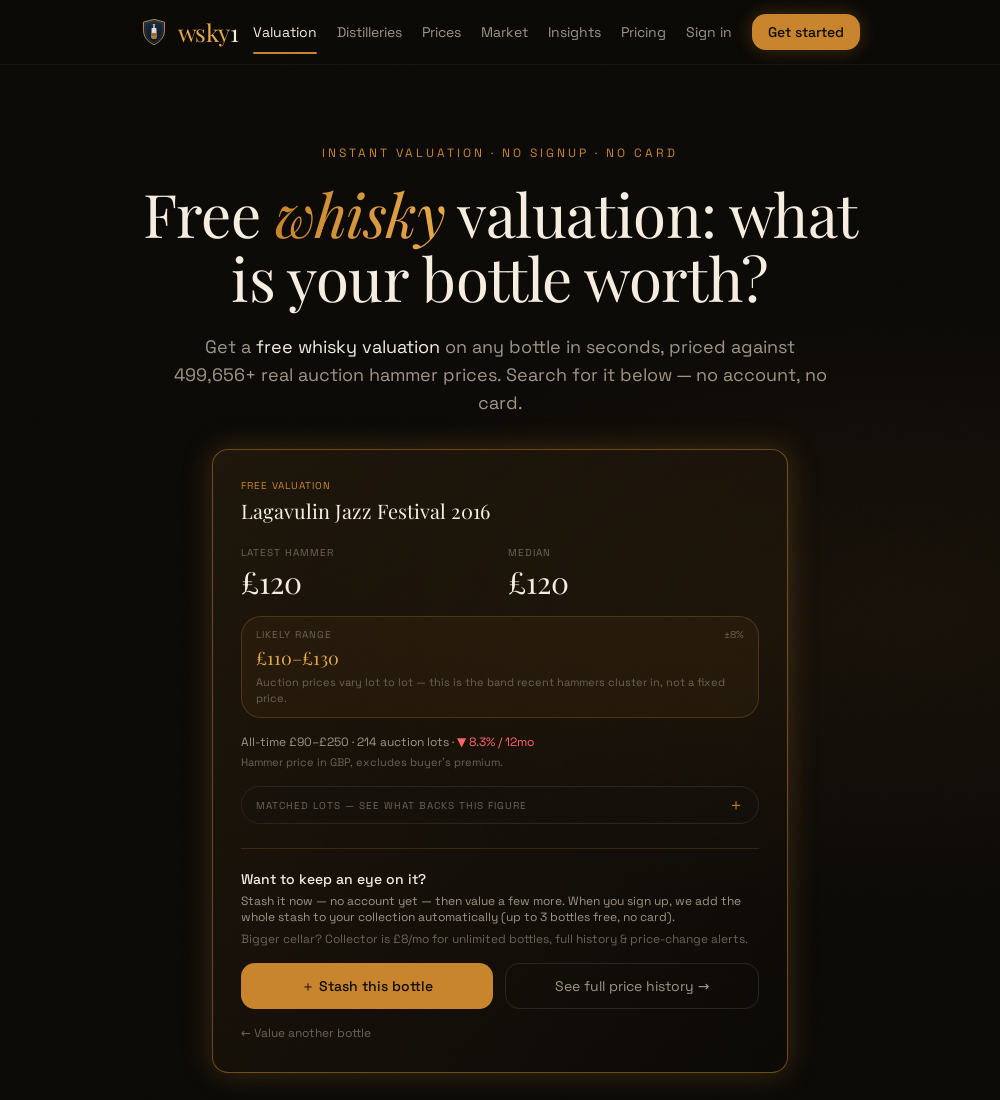
Valuing inline draws a Free valuation card for that exact expression:
| Figure | What it is |
|---|---|
| Latest hammer | The most recent price the bottle sold for at auction |
| Median | The typical hammer price across its sales |
| Likely range | A low–high band around the value, with the spread (e.g. ±12%) — because auction prices swing lot to lot on condition, fill level and timing |
| All-time low–high · N lots | The full observed range and how many real auction lots back the figure |
| 12-mo trend | The year-on-year move, ▲ up or ▼ down |
Every figure is a hammer price in GBP and excludes buyer's premium (see Where prices come from). How the likely-range band is measured — the windows, the sample-size rules, the ±8% to ±40% clamp — is covered in Valuation & confidence bands.
Expand Matched lots — see what backs this figure to see the individual sales behind the number — each row is a real lot with the month it sold, the auction house, and the hammer price — then follow See the full price history & chart → to the bottle's price page.
Example
The card in the screenshot above is a real result — searching Lagavulin and valuing the Jazz Festival 2016 release inline. Its headline reads:
Free valuation — Lagavulin Jazz Festival 2016

Latest hammer   £120        Median   £120
Likely range    £102–£137
Hammer price in GBP, excludes buyer's premium.
Treat the likely range, not the single latest figure, as the bottle's value — and remember a buyer pays roughly 24–28% on top in buyer's premium at the major houses, so the all-in cost of winning one is higher than the hammer shown.
How to value your whisky
The tool does the mechanical part for you, but the method behind a number you can trust is the same whether you're selling, insuring, or just curious. The /valuation page walks it in five steps:
- Identify the exact expression. Distillery, age statement, vintage, bottler, cask type and edition all move the price — a standard release and a single-cask bottling from the same distillery are different bottles. Match yours precisely so you're compared like-for-like. (The search box does this by matching your bottle to a canonical entry.)
- Find comparable hammer prices. Look at what the same expression has actually sold for at auction — not asking prices or retail RRP. wsky1 pools sales across every major auction house, so you get one blended figure instead of a single cherry-picked lot. See Where prices come from.
- Read the range, not one number. The same bottle can hammer 20–40% apart lot to lot depending on condition, fill level, label integrity and who's in the room. The likely range is more honest than a single figure — value the middle, expect the spread. See Valuation & confidence bands.
- Strip out buyer's premium. Hammer prices exclude the 24–28% buyer's premium the houses add on top. Hammer is the true market value; only add the premium back when you're working out what it would cost to buy the bottle again (for example, for insurance replacement).
- Check the 12-month trend. A bottle worth £400 and falling is a different decision to one worth £400 and climbing. The card's
▲/▼ % / 12mofigure shows where the value has moved over the last year — read it before you decide to drink, hold or sell.
Auction value vs retail, dealer & insurance estimates
There are several ways to put a number on a bottle. They don't agree, and most mislead. wsky1 uses auction hammer price because it's the only one backed by a real sale of the same bottle:
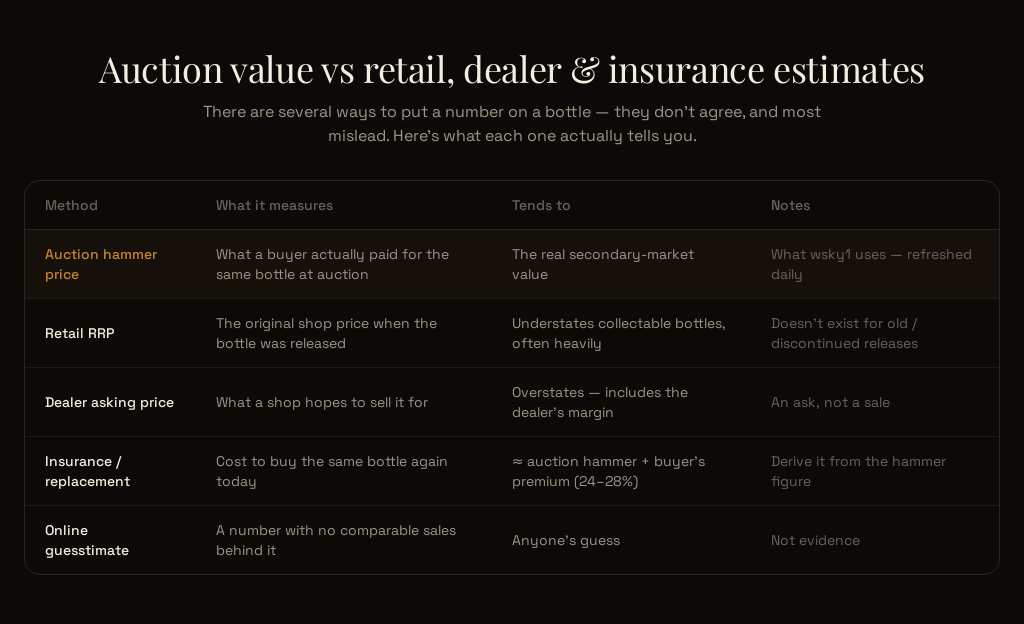
| Method | What it measures | Tends to | Notes |
|---|---|---|---|
| Auction hammer price | What a buyer actually paid for the same bottle at auction | The real secondary-market value | What wsky1 uses — refreshed daily |
| Retail RRP | The original shop price when the bottle was released | Understates collectable bottles, often heavily | Doesn't exist for old / discontinued releases |
| Dealer asking price | What a shop hopes to sell it for | Overstates — includes the dealer's margin | An ask, not a sale |
| Insurance / replacement | Cost to buy the same bottle again today | ≈ auction hammer + buyer's premium (24–28%) | Derive it from the hammer figure |
| Online guesstimate | A number with no comparable sales behind it | Anyone's guess | Not evidence |
Valuing for insurance or probate
For insurance or an estate (probate) valuation you want replacement / market value — what it would cost to buy the same bottle again today. Auction hammer prices track that closely; add roughly 24–28% buyer's premium on top for the real replacement cost.
- Value each bottle in the free tool and note the figure and the date — auction values move, so a valuation is only meaningful with the day it was taken.
- Keep those figures as your record. For a whole collection, a tracked portfolio keeps a dated valuation for every bottle in one place and re-prices it daily.
- For a high-value collection or a formal estate valuation, use these figures as your evidence base and confirm with a specialist valuer.
wsky1 is a valuation and tracking tool, not an auction house — it never lists, sells, or shares your bottles, so you can value privately and decide what to do on your own terms.
Value by distillery
The distillery is the single biggest driver of a bottle's auction value — a discontinued or closed-distillery release (Port Ellen, Brora, Rosebank) can be worth many times a standard bottling from a large active distillery. The /valuation page has a How much is my whisky worth, by distillery? section covering the most-searched names — Macallan, Springbank, Ardbeg, Lagavulin, Laphroaig, Highland Park, Dalmore, and closed distilleries — each card showing the typical (25th–75th percentile) auction range across every expression wsky1 tracks for that name, and linking to the distillery's full page.
A distillery only appears once it has enough priced bottles for a real range, so the figures are never invented. Use it to get a sense of where a name sits, then search your exact bottle above for its own figure. To browse every tracked distillery, see Browse distilleries; for a distillery's 12-month returns and buyer's guides, see Investment & buying guides.
No auction data yet?
If we don't have hammer prices for that exact expression, the card says so — "We don't have auction data for this exact bottle yet." Try a different expression (age, vintage, or bottler), or browse all tracked bottles. Limited, discontinued and closed-distillery bottles are exactly where auction data matters most, so it's worth checking a close match.
Keep the bottle: stash, then claim on signup
Found a bottle you want to keep an eye on? You don't need an account to start:
- On the valuation card, click + Stash this bottle. It's saved on your device — no signup.
- Click ← Value another bottle and stash a few more. The stash holds up to 3 bottles (
Your stash · N/3) and shows a running total value. - Click Create a free account & claim these bottles →. When you sign up, the whole stash is added to your collection automatically.
The Free plan tracks up to 3 bottles with daily revaluation and 12 months of history, no card required. For a bigger cellar, Collector is £8/mo for unlimited bottles, full price history, and price-change alerts — see Account & billing.
Notes & limits
- One bottle, free, anonymous. Valuing a single bottle needs no account and no card. Signing up is only for tracking a collection over time.
- Priced bottles only. The search returns bottles that have real auction sales behind them — it won't surface a bottle that has never traded at the houses wsky1 tracks.
- Hammer prices, GBP, ex-premium. Nothing here includes buyer's premium; see Where prices come from for the houses covered and the premium math.
- Stash is device-local. Stashed bottles are saved in your browser until you sign up — clearing site data loses them.
- Not investment advice. Valuations measure where the market has cleared, not what your bottle is guaranteed to fetch.
Related
- Try the demo — build a whole throwaway portfolio, not just one bottle, with no account.
- Getting started — turn a valued bottle into a saved, tracked collection in about 90 seconds.
- Valuation & confidence bands — how the estimate and likely range are calculated.
- Look up auction prices — the full per-bottle price pages behind each valuation.
- Browse distilleries — the directory behind the "value by distillery" section.
- Investment & buying guides — a distillery's returns, where to buy, and best-by-year roll-ups.
- Where prices come from — the auction houses, hammer vs. premium, and cross-house pooling.