Look up auction prices
Find any collectable Scotch bottle's latest hammer price, 24-month median, and full price history — free and without an account — from the public /prices pages.
Want to know what a bottle actually sells for? Look it up on the public price pages — no account needed. Every priced bottle has its own page showing the latest hammer price, a 24-month median/high/low, a monthly price-history chart, and a per-auction-house breakdown. All figures are hammer prices in GBP (see Where prices come from for what that excludes).
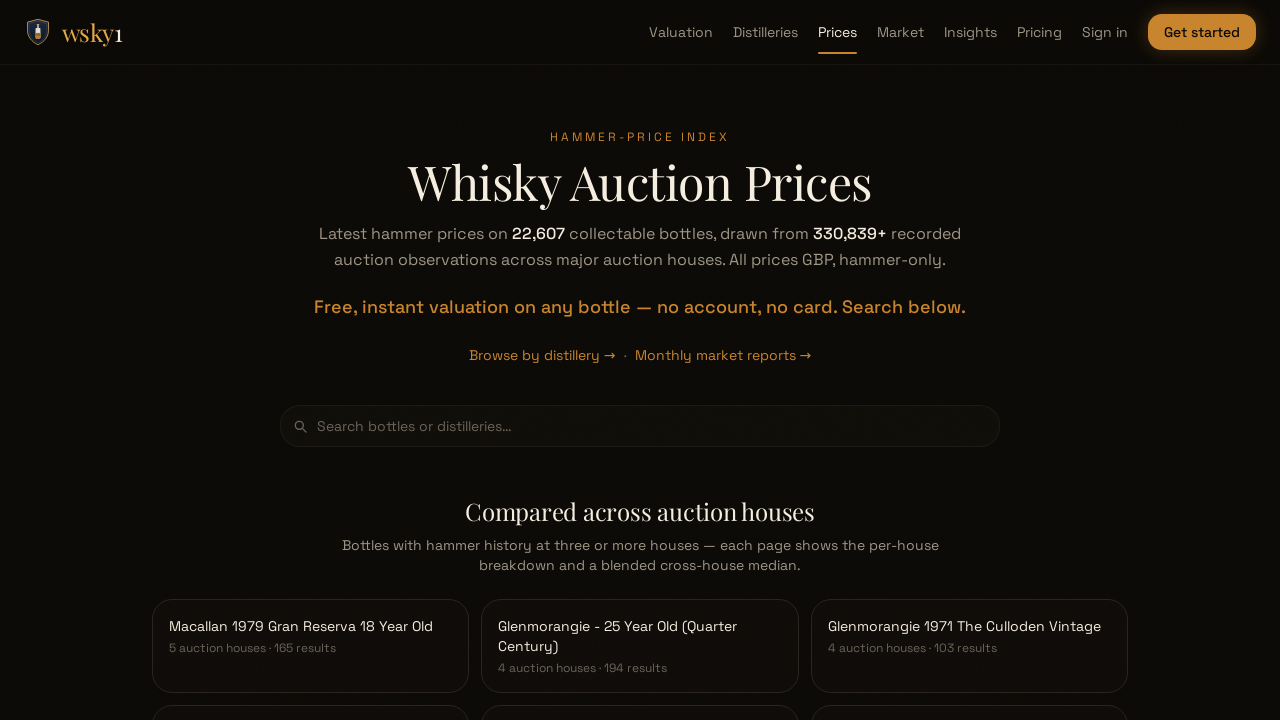
Find a bottle
There are three public entry points, all under wsky1.com/prices:
- The prices hub (
/prices) — the top-level index. It shows how many bottles are tracked, groups them into an A–Z by distillery initial, and links a "seen across auction houses" shortlist of bottles with hammer history at 3 or more real houses. - A letter page (
/prices/letter/a…/prices/letter/z, plus#for 0–9) — every tracked bottle whose distillery starts with that letter, grouped by distillery. Each card shows the bottle name, its latest hammer price, and how many observations back it. Cards link straight to the bottle page. - A bottle page (
/prices/<bottle-slug>) — the detail page for one canonical bottle. This is where the numbers live.
If you're logged in and want to track a bottle rather than just look it up, use the portfolio picker instead — see Getting started.
What a bottle page shows
Take any bottle page (for example /prices/lagavulin-16-year-old). Top to bottom:
- Header — an engraved plate of the bottle (click it to zoom), then the distillery (a link to its distillery page), bottling year, ABV and size where known, and the bottle's display name.
- About {Distillery} — a short evergreen orientation on the distillery, so the page makes sense even if you've never heard of it.
- What drives this bottle's value — the concrete scarcity and demand signals wsky1 reads straight off the bottle's own attributes (never a price prediction). Any that apply are listed: Closed / ghost distillery, Single vintage (distilled in one year), Age statement / Considerable age (18+ / 25+ years), Single cask, Named / limited release, Cask type (sherried casks are flagged as especially sought-after), Independent bottling, High bottling strength (≥50% ABV), and Non-standard format (not 700ml). A bottle with none of these gets an honest one-liner instead — that it's a standard release whose value rides on ongoing demand for the distillery rather than built-in rarity. The block ends with a "these describe the bottle, not a prediction — not investment advice" note.
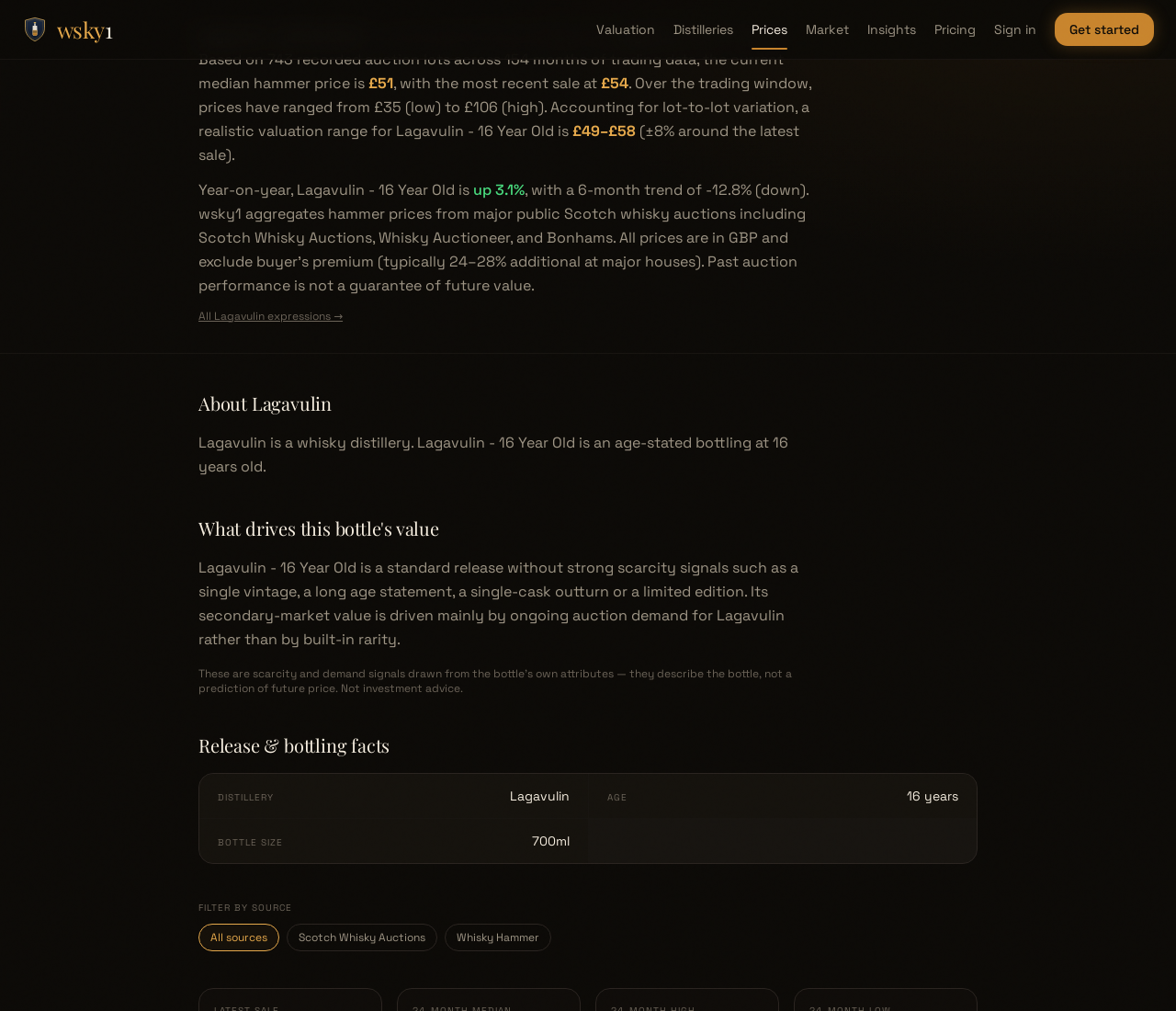
Release & bottling facts — a two-column table of the structured attributes wsky1 holds for the bottle, in order: Distillery, Region, Expression, Age, Vintage, Bottled, ABV, Cask, Cask number, Bottler, Edition, Bottle size. Only fields that exist for the bottle appear (bottle size always shows — it defaults to 700ml).
Filter by source — when a bottle has traded at two or more houses, a row of pills (All sources + one per house) reloads the page's stats, chart and results scoped to a single auction house (
/prices/<slug>?source=<house>).The four headline stats:
Stat What it is Latest sale The most recent hammer price observed for this exact bottle 24-month median The median hammer over the last 24 months — the robust "typical" price 24-month high Highest hammer in that window 24-month low Lowest hammer in that window Estimated value · likely range — a low–high band around the latest sale (e.g.
£1,760–£2,240 ±12%), because a single hammer figure is false precision. How the band is measured is covered in Valuation & confidence bands.Market presence — how tradable or rare the bottle is, from the real number of auction lots seen over the last 12 months. A five-segment bar rates it from Highly liquid ("easy to find — and to sell") down through Regularly traded, Scarce at auction, and Rare at auction, to Hardly ever seen. Alongside it: Seen at auction (lot count), Cadence (e.g.
≈ 3 per monthor≈ every 61 days), Trend vs. the prior year, how many Houses carried it, its Activity rank (top N%of tracked bottles), and Last seen. The same count reads two ways — high means liquidity, low means rarity — so a bottle with few lots but spread across three or more houses gets flagged as a genuine rarity signal (sellers seek it out).Seen across auction houses — when a bottle has traded at two or more real houses, a table breaks it down: Auction house · Price points · Latest hammer · Median, plus a blended cross-house median. This is the comparison no single auction house can publish, because each only sees its own lots.
Price history (monthly median) — a chart of the bottle's monthly median hammer over roughly the last 12 months.
Recent auction results — a table of the most recent months: Month · Sources · Median · Lots.
Comparable bottles — pill links to related pages: More from {Distillery} (sibling expressions, plus an All {Distillery} whisky prices → link to the distillery page) and {Region} peers (bottles from other distilleries in the same region). Shown only when there are comparables to link.
FAQ — auto-generated answers for that specific bottle (current price, year-on-year change, where to sell, and the buyer's-premium math).
Example: reading the price, not just the number
A bottle whose Latest sale is £2,000 with a measured spread of 12% is shown as:
£2,000 (£1,760–£2,240)
Treat the band, not the single figure, as the bottle's value — auction hammers swing lot to lot on condition, fill level, and timing. And every price on wsky1 is the hammer only: at major houses the buyer pays roughly 24–28% on top in buyer's premium (so a £2,000 hammer costs a buyer about £2,520 all-in). See Where prices come from.
Get the data as JSON
Every bottle page has a machine-readable twin: append .json to the URL.
curl https://wsky1.com/prices/lagavulin-16-year-old.json
The page also advertises this as an alternate link (application/json) in its head, so tools that follow alternates find it automatically. For the full response shape, the companion /catalog/<key>.json endpoint, and the /llms.txt files for AI agents, see Data & API access.
Notes & limits
- Hammer prices, GBP, ex-premium. Nothing on these pages includes buyer's premium — see Where prices come from for the houses covered and the premium math.
- The 24-month window governs the headline median/high/low stats; the confidence band is measured over a rolling 12 months (widening to full history when recent sales are thin). The two windows are intentionally different — see Valuation & confidence bands.
marketis synthetic. A per-distillery "Market estimate" aggregate is excluded from any real-house breakdown — it isn't an auction house.- Refresh: prices update daily. See Market reports for the monthly rollups.
Related
- Browse distilleries — every bottle page links up to its distillery.
- Data & API access — the machine-readable JSON twin of every bottle page.
- Where prices come from — the auction houses, hammer vs. premium, and how the same bottle is pooled across houses.
- Valuation & confidence bands — how the estimate and range are built.